
I did not invent moderation. Researchers did.
The Sobell studies in the 1970s showed that drinkers given tools could control their use. The RAND reports of 1976 and 1981 found that non-dependent drinkers could return to drinking without escalating. G. Alan Marlatt helped establish harm reduction as a pragmatic and compassionate approach to alcohol treatment, and the Institute of Medicine said in the 1990s that we needed treatment alternatives to abstinence.
Fifty years of research, and the field has been slow to catch up.
Only 6% of people who drink meet criteria for severe Alcohol Use Disorder. That leaves a much larger group sitting in the middle: people who drink more than they’d like, who worry about it, who are not dependent but are not comfortable either.
For years, most U.S. treatment programs told this entire population the same thing: stop completely, or you have not really tried.
A client told me once, “If I had known this information in my 20s and 30s, I would not be the ‘alcoholic’ I am today in my 50s.”
I have never forgotten that sentence. It is why I do this work, and it is the reason I keep coming back to one question: What if we told people the truth about their drinking before they hit bottom, instead of waiting until abstinence was their only option?
Why moderation can work
Here is why I believe moderation works better than abstinence for most of the people sitting in my office.
Abstinence asks someone to accept a permanent identity—“alcoholic”—before they have even decided whether they have a problem. That is a high bar, and it is one reason people may avoid treatment altogether rather than agree to it.
Moderation asks smaller, more honest questions: can you drink less, more safely, and does that get you your health, your relationships, and your mood back?
For most drinkers, the answer is yes. Treating the why behind the drinking, rather than mandating the don’t, keeps people in the room and in the conversation. A closed door helps no one.
Moderation is not right for everyone
None of this means moderation is right for everyone. That is the reason I developed the Alcohol Moderation Assessment.
The assessment looks at a person’s recent drinking through three layers: general risk factors, more serious warning signs such as withdrawals and blackouts, and protective factors such as alcohol-free interests, support, and a willingness to try a period of abstinence. It produces a score designed to help identify whether moderation is a realistic goal or whether a higher level of care may be safer.
The score is not a one-time pass-or-fail judgment. It is a starting point for an honest conversation about where someone stands, what support they may need, and whether moderation is likely to help.
For some people, moderation can be a sustainable path. For others, it may become a bridge to abstinence, on their own terms and in their own time. And for some, abstinence or a higher level of care will be the safest choice from the beginning.
What happens when people try moderation
The data on what happens when we let people try moderation is not theoretical anymore.
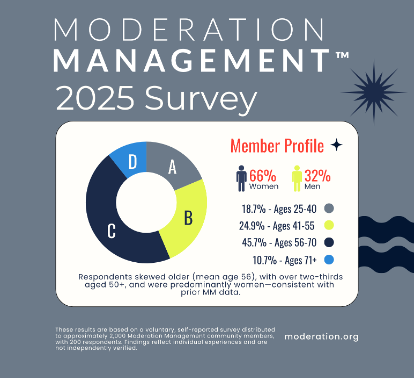
Moderation Management surveyed nearly 300 members between June and August of 2025.
Ninety-five percent reduced their alcohol consumption. Forty-three percent cut their drinking by half or more. Eighty-five percent said they were less likely to engage in harmful drinking patterns.
For more than half of them, MM was the first program they had ever tried—not a last resort after abstinence-only treatment had failed them.
Nearly 90% named moderation itself, not abstinence, as a top reason they stayed. And for 10% of them, moderation became the bridge to full abstinence anyway, on their own terms, in their own time.
People need specifics
General advice to “drink less” does not help the person standing in their kitchen at 9:00 p.m., wondering if the glass in their hand is the problem. Specifics do.
People need honest information about their risk. They need practical tools, support, and a way to measure whether change is actually happening. They also need options that reflect the fact that alcohol problems exist on a spectrum. Waiting until abstinence is the only safe choice is not early intervention.
Is moderation possible?
Fifty years of research says yes for many people who drink. My own clients say yes, provided the door stays open long enough for them to walk through it. The data from MM’s members says yes, measurably, this year.
What I want every clinician and every person struggling with their drinking to walk away with is this: The question is not simply whether someone can moderate. The question is whether we are willing to give them an honest tool, tell them the truth about where they stand, and let them try.
By Cyndi Turner, LCSW, LSATP, MAC, Chair of the Moderation Management Board of Directors and Co-Founder of Insight Into Action Therapy and Insight Recovery Centers.
At Moderation Management’s Virtual Summit, Cyndi will take the Alcohol Moderation Assessment off the page and walk through how it works: the questions it asks, the risks and protective factors it weighs, and what the results can tell us about whether moderation is a realistic path. Register here to attend.

I have found that Moderation is the only way I can actually deal with and handle my drinking to my liking!
I have tried the traditional 12 step program and successfully completed a two year sober pin…..
It was then that I learned about Moderation Management. I knew with this program I would be able to attain any level of drinking that would fit my lifestyle.
I used to shy away from parties and social events because I didn’t want to test my resolve so I just avoided all contact where alcohol would be present!
Now, I can go into any situation and be able to confidently handle and control, if you will, my drinking!
It has made me so much happier, not having to have that little voice in my head asking me if I am an alcoholic or not! It made me question everything I knew about drinking! I grew up with a very social drinking family. Every event we had as a family gathering, drinks were flying around the room, so I grew to take that as social norm.
I saw drunk aunts and uncles and thought they were hilarious! It was not a big deal to get tipsy now and then, with them.
But when I hit the bottom, I was lucky and didn’t have to face the losing a home/wife/job trifecta……
Huzzah!