
Legal Disclaimer: This article is for informational purposes only and should not be considered legal advice. If you have questions about DUI laws or charges, consult a qualified professional. For immediate assistance about alcohol monitoring tools, contact Keepr® at (833) 743-5969.
Adjusting your alcohol use is rarely a linear path. Help meet your moderation goals, track your progress, and use a feedback loop to create lasting change.
You may have a picture in your mind of what more responsible or moderate drinking looks like. For some people, that means choosing not to drink at all, enjoying mocktails instead of cocktails, or avoiding social situations centered on alcohol. For others, it may mean taking alcohol-free days during the week, setting limits for weekends, or waiting until a certain time of day before having a drink.
Whatever goal you make comes with expectations. And if you stray from that goal, these self-imposed rules might trigger some anxiety, feelings of failure, or a blow to your self-esteem.
“Sometimes people connect with shame because it feels like a way to punish myself, but also still suffer,” says Calvina Ellerbe, an award-winning educator, TEDx Speaker, and writer. “Like, I kind of make myself suffer a little bit, but it doesn’t actually change me. So, I punish myself emotionally.”

Dr. Calvina Ellerbe
But moderating drinking habits isn’t necessarily a straight line, and that’s where an objective feedback loop can help.
Everything in Moderation: Why Feedback Matters
It’s normal to want to be immediately good at something you decide to do. But it takes time and effort to develop a skill. And if we think of moderation as a skill, you need to practice.
Sometimes you can practice alone and stay on track. But sometimes you need some feedback, or a coach, to support your progress.
A difficult week, an unplanned drink, or a goal that no longer fits isn’t proof of failure. It’s useful information about triggers, context, boundaries, and support needs.
Why “All or Nothing” Thinking Makes Change Harder
The moment you rely on absolutes to make change in your life, you may be accidentally setting yourself up to fail. Why? Because you’re human, and life happens.
“Guilt and shame have no place in making any form of a decision, ever,” says Dr. Ellerbe. “It’s not a beneficial tool. The only tool that is beneficial in making a decision is, ‘where do I want to go and why?’ The why is very, very, very important.”
Creating a feedback loop can help you uncover what may be getting in your way.
Using a Feedback Loop to Support Drinking in Moderation
A feedback loop is a process of setting a goal, paying attention to what happens, and using what you learn to make a small change next time. If you are intentionally trying to drink less, it can help if you notice patterns, such as certain situations, emotions, or routines that affect your choices. Instead of treating one difficult night as failure, you can use it to adjust your plan and keep moving toward your goal.
Intend→Notice→Observe→Reflect→Adjust
As part of a comprehensive plan to moderate your drinking, real-time feedback and objective data provided by personal breathalyzers can help make this learning cycle easier.
How Keepr Helps Provide a Feedback Loop
While alcohol moderation looks different for everyone, certain tools can provide necessary data and insights to help you stay on track and meet your goals.
“When you have that data and it’s telling you what it is versus you didn’t feel like it was that bad… that’s absolutely important,” says Dr. Ellerbe. “Being truthful, connected, and willing to create parameters and experiences around yourself can help you reach a goal.”
The Keepr® family of breathalyzer products can support each step of a feedback loop by helping turn intentions into practical actions.
- Keepr Breathalyzer is a compact, discreet wireless device that gives you an accurate* BrAC reading in seconds, providing immediate data to evaluate your alcohol use. (*Accuracy level of Keepr device readings is ±0.005 within a range of 0.010 to 0.050 g/210L.)
- Keepr Alcohol Monitoring is a more robust alcohol monitoring solution, combining the Keepr Breathalyzer, a companion mobile app, and a monitoring portal for providers to access and share results.
- Keepr Drive can help deliver extra information behind the wheel. It connects the Keepr Breathalyzer to your vehicle’s ignition. When enabled, it prevents your car from starting if you fail a pre-set breath alcohol test level. You can also share and/or monitor test results in the companion app.
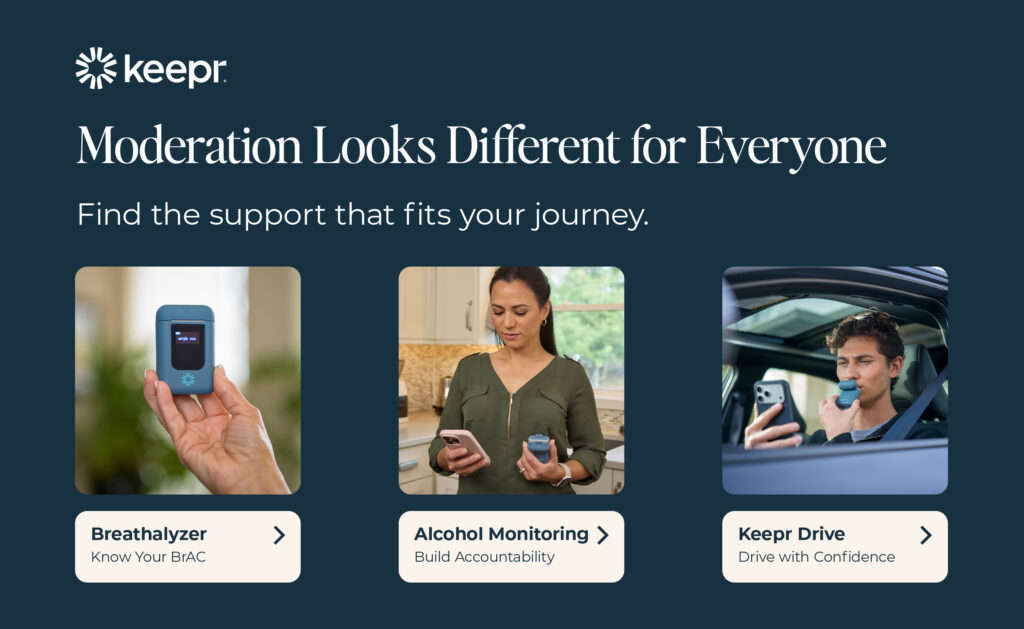
Keepr’s connected breath-testing and tracking capabilities can be used as a source of neutral, real-time data in a broader personal feedback loop. Keepr can help you notice what is happening, reflect on your choices, and plan your next step.
How Does Keepr Support Alcohol Moderation?
While numbers don’t define your progress, they can help you identify the gap between how you feel and how alcohol may be affecting you.
Here’s how Keepr can help you:
- Discreet testing: A compact, handheld device you can use anywhere.
- Secure result-sharing: Every result is encrypted and only visible to contacts you choose.
- Custom testing schedules: Set up a testing routine that supports your goals.
- Verifiable results: Every shared result includes a time-stamped photo and location, so the people you share with can trust it’s really you.
It does not make decisions for you or define success, but Keepr’s products can give you useful information and support as you work toward your own drinking moderation goals.
What to Track Beyond Number of Drinks
Tracking how much you drink can be helpful, but it is not the only thing to notice. These details can also help you spot patterns and make changes that support your goals.
- Setting: Notice where and when you are most likely to drink. This may include social events, work gatherings, or time at home alone.
- Sleep: Pay attention to how drinking, or not drinking, affects your sleep. Notice if you fall asleep easily, wake up during the night, or feel rested the next day.
- Mood: Track how you feel before and after drinking. You may notice connections between alcohol, stress, anxiety, energy, or low moods.
- Transportation: Make a note of your plan for getting home. A rideshare, public transportation, or a designated driver can help you avoid making a risky decision later.
- Next-day impact: Notice how you feel the next morning. Consider your energy, focus, mood, and physical symptoms, then look for changes over time.
When Feedback Suggests It’s Time for More Changes
The longer you work your moderation plan, the more you may notice patterns in your thoughts, habits, and behaviors. And you may realize your progress is not linear. Some days or weeks may feel easier than others as you learn from your feedback loop. That is okay.
If you begin to feel stuck or are not making the progress you hoped for, it may help to consider:
Setting Different Goals
Your original goals may have been too ambitious for where you are right now, or they may no longer challenge you in a meaningful way. Either way, adjusting your plan is part of the process. You can set goals that feel more realistic, more supportive, and more aligned with what you are learning about yourself.
Getting More Support
Creating change does not have to be something you do alone. Extra support can make it easier to stay connected to your goals, work through challenges, and continue moving forward. That support might come from a peer group, therapist, trusted friend or family member, online resource, sobriety-tracking app, or personal breathalyzer.
The right tools and support will depend on your needs, your goals, and what helps you feel accountable.
Setting Yourself Up for Moderation Success
No matter what happens, remember that learning to drink in moderation is a journey. You can always adjust your goals as you learn from your feedback loop.
And if your journey is hard, embrace it, says Dr. Ellerbe. “There is nothing we’re going to do that’s worth anything in our lives that doesn’t require accountability and effort. Nothing.”
From our partners at Keepr. To learn more about Keepr, visit our website.