Between June and August 2025, nearly 300 Moderation Management (MM) members took part in a comprehensive member survey designed to better understand who MM serves, how members engage with the program, and what impact MM is having on their lives. The findings paint a clear and consistent picture: MM is delivering meaningful, measurable benefits for adults who want a compassionate, flexible approach to changing their relationship with alcohol.
Rather than reflecting quick impressions or early-stage experiences, the survey captures the voices of people who have stayed engaged—and who are seeing real results.
Taken together, these findings place MM among a small number of programs that can point to both high engagement and measurable behavior change—without requiring abstinence as a starting point.
Who Participated in the 2025 Moderation Management Member Survey
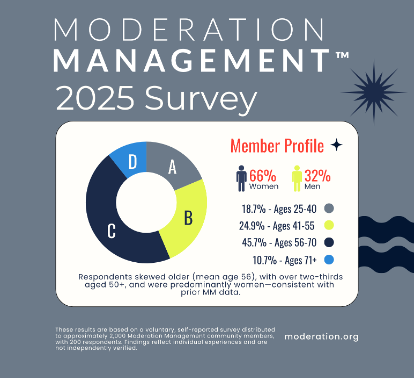
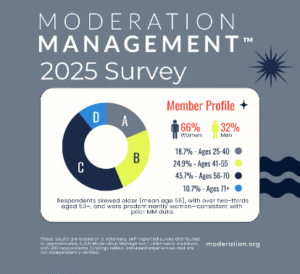
Survey respondents skewed older, with a mean age of 56. More than two-thirds of participants were aged 50 or above. Women made up roughly two-thirds of respondents, a pattern consistent with prior Moderation Management surveys.
 Members came from 36 U.S. states and six additional countries, though the majority currently live in the United States. Importantly, most respondents were not new to the program: more than two-thirds had been participating in MM for at least one year. This means the findings largely reflect sustained engagement and longer-term experience, rather than first impressions.
Another notable insight: for more than half of respondents, Moderation Management was the first program they tried to address concerns about alcohol. For others, MM followed experiences with abstinence-based programs or outpatient treatment. Together, these responses highlight MM’s role as both an entry point and an alternative within the broader recovery landscape.
What Members Say Helps Most
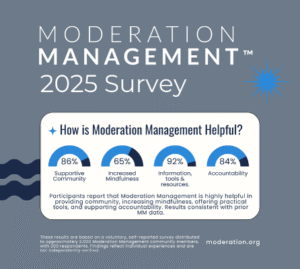
Quantitative results from the Moderation Management member survey show exceptionally strong ratings across MM’s core offerings. Members overwhelmingly reported that MM:
- Provides a supportive, non-judgmental community
- Increases mindfulness and self-awareness around drinking
- Offers practical, usable tools and resources
- Supports accountability to personally defined goals
Across these areas, between 84% and 93% of respondents said MM was “somewhat” or “very much” helpful, with average ratings above 3.2 on a 4-point scale.
 The qualitative responses explain why those ratings are so high. Again and again, members emphasized the emotional safety of MM’s community:
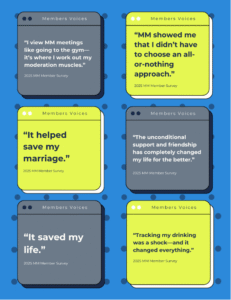
“The unconditional support and friendship has completely changed my life for the better.”
“Being able to speak openly about drinking without judgment is incredibly calming, helpful, and validating. It gives you the strength to make real changes in your life.”
MM’s virtual meetings emerged as a cornerstone of the member experience. Participants described meetings as a source of structure, accountability, and motivation—often using fitness metaphors to explain their value:
“I view MM meetings like going to the gym; it’s where I work out my moderation muscles.”
Measurable Changes in Drinking and Well-Being
The data from the 2025 Moderation Management member survey show a strong association between MM participation and clear, sustained behavioral change. Since becoming involved with MM:
- 95% of respondents reduced their alcohol consumption
- 43% reduced drinking by 50% or more
- 85% reported being less likely to engage in harmful drinking
- The majority reported meaningful improvements in health, sleep, and relationships
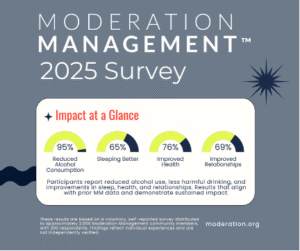 In behavioral health research, results like these are notable: particularly because they come from a population that is largely older and long-engaged, rather than newly enrolled.
Members’ personal accounts bring these numbers to life. Many described a shift away from mindless or compulsive drinking toward more intentional, informed choices:
“Joining MM completely changed my relationship with alcohol. I was able to go from weekly binge drinking to long-term moderation. It’s been a huge improvement in my life, health, and personal relationships.”
“When I started tracking, it was a shock to see how much I drank. Over time, I reduced from over 50 drinks a week to about 10.”
Others spoke more broadly about improved mental health, stronger relationships, and increased self-confidence:
“It’s made a huge difference in how I live my life and how I engage with others.”
For a subset of respondents, the impact of Moderation Management was described as profound—and even life-saving:
“I probably wouldn’t be alive if it wasn’t for MM.”
“It saved my marriage. I will never go back to my old lifestyle.”
Why Moderation Matters
One of the clearest findings in the Moderation Management member survey is the importance of MM’s moderation-friendly, non-absolutist approach. Nearly 90% of respondents cited moderation—rather than abstinence—as a top reason for choosing MM.
Qualitative responses make clear that this flexibility is about being met where you are, without pressure or shame:
“MM showed me that I didn’t have to choose an all-or-nothing approach.”
“It was the first place where moderation felt possible—and legitimate.”
Importantly, several participants noted that MM supported either long-term moderation or a gradual transition toward abstinence, depending on individual needs—without rigid rules or judgment.
“MM was a great segue for me into the abstinence that I am now maintaining… I really appreciate that there are no hard and fast ‘rules’ like in some organizations. The flexibility of MM’s approach really works for me.”
At a time when public conversations about alcohol often default to extremes, MM’s data show that moderation is not only viable: it’s effective for a wide range of adults, including those who have struggled in abstinence-only settings. For some, it’s also the ideal pathway to abstinence: 10% of respondents ended up abstaining completely.
What These Findings Point To
Taken together, the 2025 Moderation Management member survey underscores a simple but powerful truth: when people are offered compassion, practical tools, and autonomy, meaningful change is possible. For hundreds of members, MM isn’t just a program—it’s a sustainable framework for building a healthier, more intentional relationship with alcohol. And at a broader level, the survey offers something rare: clear evidence that a moderation-based, nonjudgmental approach can deliver lasting, meaningful change at scale.