
The Stages of Change model can help you understand why changing your drinking is rarely a straight path, and why progress may look different at different times.
Understanding the connection between the Stages of Change and alcohol moderation can help us move beyond the question of whether someone is simply “ready” or “not ready.” Instead, the model invites us to ask what kind of change a person is considering, what matters to them now, and what support might help.
What Is the Stages of Change Model?
The Stages of Change model, developed by James O. Prochaska and Carlo C. DiClemente, offers a way to understand how we move toward changing a behavior. Someone may not yet be considering change, may be weighing the pros and cons, may be preparing to act, or may already be working to sustain a new behavior.
These stages are commonly described as:
- Precontemplation
- Contemplation
- Preparation
- Action
- Maintenance
Importantly, we do not move through them in a straight line. We may pause, reconsider, return to an earlier stage, or be ready to change one part of a behavior but not another.
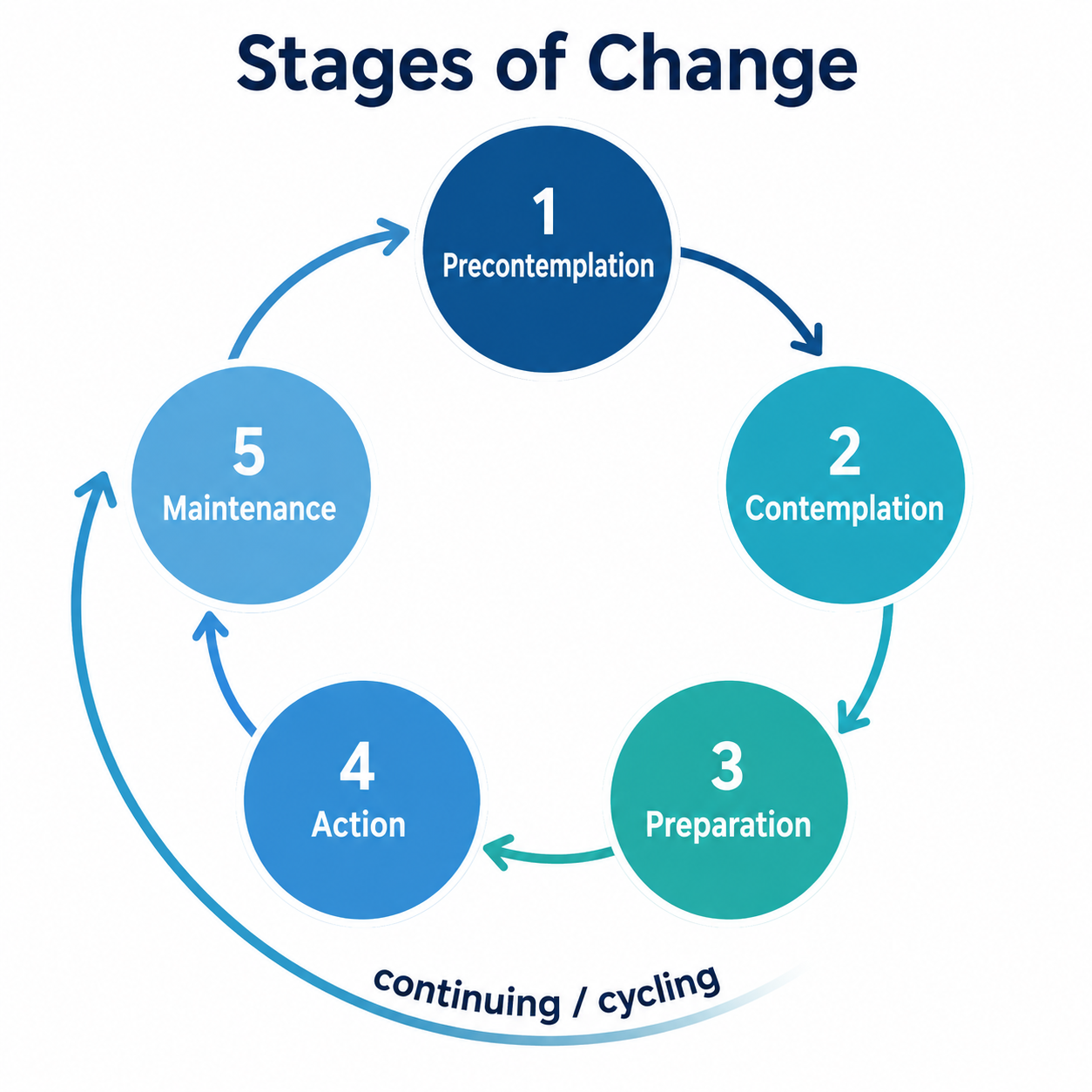
Setbacks are part of the process, not proof that change has failed.
Used well, the model is not a test we must pass before receiving help. It is a way of understanding where a person is today so that support can match the change they are actually considering.
One of the reasons I continue to come back to the Stages of Change model is that it reminds me of something often lost in conversations about alcohol and substance use. Change is not linear, and it doesn’t belong to the professional—it belongs to the person.
Readiness Is Not a Verdict
As both an educator and treatment provider, I practice from a harm reduction perspective. That means I don’t view the Stages of Change as a tool for determining whether someone is “ready” for treatment. I see it as a framework for understanding where a person is today, so we can respond with curiosity rather than assumptions. It invites me to meet people where they are and recognize their autonomy, and support change in ways that align with their own goals and values.
Too often, treatment systems have been built around the question, “Is this person ready to stop?” But that question can unintentionally narrow the focus. What if instead the question was, “What matters to this person right now?” or “What change, if any, are they interested in making?”
Sometimes change means making substance use safer, reducing use, or stopping altogether. Other times it means rebuilding trust with family, improving sleep, avoiding withdrawal, or simply surviving another week.
Goals that are not directly about stopping substance use are not lesser goals. They are meaningful changes, and they deserve to be taken seriously.
How the Stages of Change Apply to Alcohol Moderation
The Stages of Change model is often discussed as though it applies only to abstinence, but it can apply to any behavioral or relationship change.
In the context of Stages of Change and alcohol moderation, a person may want to:
- Moderate their drinking
- Use a breathalyzer to gather information
- Have an alcohol-free day
- Reduce binge-drinking episodes
- Stop driving after drinking
- Pursue abstinence
In any of these cases, the process of change is unfolding. This model teaches that readiness is specific to the goal, not a label placed on a person.
I believe the Stages of Change model can guide how providers plan support with someone. Matching that support to where someone actually is, not where anyone wishes they were, creates opportunities for engagement instead of resistance. When professionals push someone toward a goal they have not chosen, we may mistake pushback for “lack of motivation.” Often, the problem is a mismatch between the professional’s goal and the person’s own priorities.
Choose the Change That Matters to You
The most useful goal is not necessarily the largest or most dramatic one. It is the goal you are genuinely willing to explore now.
Matching support to where a person actually is, rather than where anyone wishes they were, creates opportunities for engagement instead of resistance.
One of my favorite aspects of motivational work is that it asks me to respect autonomy while remaining deeply hopeful, meeting people with warmth no matter where they are. I don’t have to convince someone to change in order to support change. I can walk alongside them, help them explore ambivalence, celebrate small wins, and recognize that setbacks are part of learning rather than evidence of failure.
The Stages of Change model reminds us that all of us move, pause, circle back, and move forward again. Individual providers may work from this perspective, but treatment systems are rarely designed to honor it.
If you’ve ever felt like you “failed” treatment, it may be worth asking whether the goal was ever really yours. The problem may not have been a lack of motivation. It may have been a mismatch between the goal you were offered and the change you were ready to make.
Meaningful Change Can Take More Than One Form
Change does not have to mean moving immediately toward abstinence. It can begin with curiosity, information, a safer choice, a smaller goal, or a willingness to examine what is and is not working.
The relationship between the Stages of Change and alcohol moderation gives us a more flexible way to understand progress. It recognizes that people may be ready for different changes at different times, and that each meaningful step can create an opportunity for further growth.
When support begins with the person’s own priorities, there are more ways to make meaningful progress.
I look forward to exploring these ideas during the Stages of Change panel at Moderation Management’s Virtual Summit.
Holly Stoddard, MSSA, LISW-S, LICDC
Owner & Psychotherapist
Cheshire Wellness LLC