The Stigma Around Moderation Is Keeping People from Getting Help
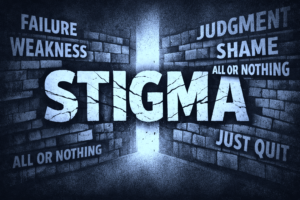
If you’ve ever Googled “how to drink less” and closed the tab when the results felt like they weren’t for you, you’re not the only one.
Maybe you’re not in crisis, but something in your relationship with alcohol feels off, and you’d like to change it. Not necessarily quit forever, just… change it.
And sometimes, that feels like it doesn’t count.
That feeling has a name: stigma. And it’s worth talking about.
The Story We’ve Been Told
For a long time, the conversation around problem drinking has been binary: either you’re fine, or you’re an alcoholic. And if you’re an alcoholic, total abstinence is the only legitimate solution.
That story is deeply embedded in how we talk about alcohol. It shapes what treatment looks like, what support groups teach, and what people assume when they hear you’re “trying to cut back.” It can make moderation feel like you’re not taking things seriously enough.
But that story isn’t the whole truth. And increasingly, the research is saying so.
What the Science Says
An expanding body of research has established that people can meaningfully reduce their drinking AND the harm that comes with it without achieving full abstinence. The NIAAA, the country’s leading alcohol research institution, now explicitly recognizes non-abstinent outcomes as valid forms of recovery.
Their researchers have also found something that will probably sound familiar: more than nine out of ten people with alcohol use disorder don’t seek help at all, because they don’t want to abstain. Opening the door to moderation as a goal may encourage more people to seek support.
In other words, the abstinence-or-nothing framework is keeping people away from support they genuinely need. A 2023 study found that beliefs like “abstinence is always necessary to recover” actively undermine people’s ability to change, and that most people with alcohol-related concerns don’t have severe problems or need to stop drinking forever.
You may be one of those people, and you deserve support that meets you where you are.
A Forgotten Group
Most alcohol treatment programs are built for people in crisis. That makes sense, but it leaves a huge group of people with nowhere obvious to turn.
If you don’t identify as an alcoholic; AA doesn’t feel like the right fit; or you just want to drink less without making it your whole identity, the current conversation can feel like it wasn’t designed for you. Because largely, it wasn’t.
That’s a gap in how our culture has historically approached alcohol. The conversation has been so focused on the most severe end of the spectrum that everyone else has been left to figure it out alone.
There’s Another Way
Moderation Management was created for people in that middle space.
There’s no label required, no shame if your goal shifts over time. Just honest tools, a non-judgmental community, and the support of people who have been exactly where you are.
The Fundamentals of MM is a good place to start if you want to understand the approach. Or you can read what real members have to say about what the program looked like for them. If you’d prefer to work with a professional, the MM Approved Provider Directory lists therapists who won’t push a one-size-fits-all solution.
You Don’t Have to Have It All Figured Out
The stigma around moderation whispers that you’re not serious about change unless you’re willing to quit entirely. That’s not true, and it’s not fair.
Wanting to drink less, feel better, and be more in control is a legitimate goal. The fact that you’re thinking about it at all says something good about you.
You don’t have to wait until things get worse to deserve help. You can start here, with exactly the goal you already have.


Leave a Reply
Want to join the discussion?Feel free to contribute!