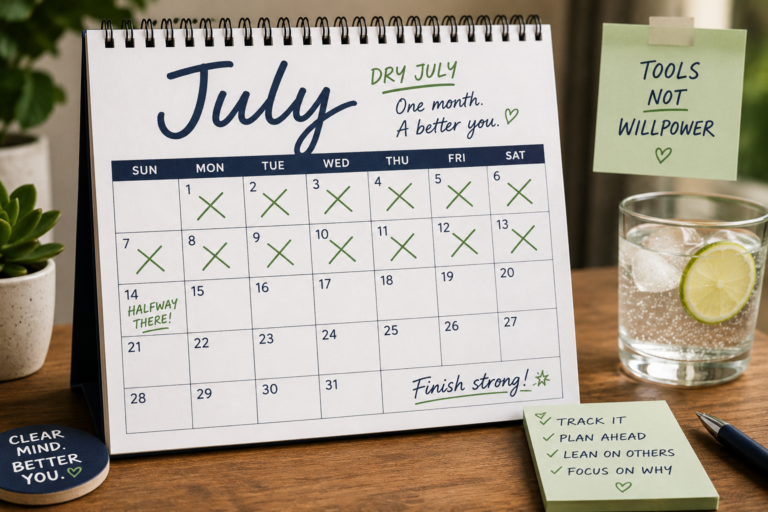
Somewhere around June 28, a lot of people decide they’re doing Dry July. By July 6, a lot of those same people are wondering why they thought willpower alone would carry them through a month that contains barbecues, beach trips, and at least one wedding.
Dry, or Just Dryer?
Dry July doesn’t have to mean zero. Some people go fully alcohol-free for the month; others aim for a “Dry(er) July,” with fewer drinks, more nights off, or some other form of deliberate scaling back. Both are legitimate, and both teach you something. Pick the version you’ll follow, not the one that sounds most impressive. Every tool below works the same either way.
How to Prepare for Dry July
Fortunately, figuring out how to do Dry July isn’t about gritting your teeth harder. It’s about setting up the right tools before the urge shows up. Even better, the right tools turn the month into more than an endurance test: they turn it into information. A month of drinking less—or not at all—is one of the best chances you’ll ever get to learn how, when, and why you drink.
Research on behavior change consistently shows that environment, routines, and social support influence drinking habits more effectively than relying on willpower alone. That’s part of why structured month-long challenges like Dry July can be useful: they create enough time to notice patterns, triggers, and habits that are usually automatic.
So skip the white-knuckling. Here’s your kit.
10 Tools That Make Dry July Easier
-
A Tracking Method
An app, a paper calendar, a sticky note on the fridge—the format matters less than the habit. Tracking is your lab notebook for the month: as well as did you drink, it can tell you how you slept, what you craved, when the urges hit. You’ll want this data later (more on that at the end).
Why it helps: What gets written down gets noticed. Patterns you’ve never seen become obvious by week two.
-
A Stocked Alcohol-Free Shelf
Don’t wait until Friday at 6pm to discover your only option is tap water. Stock up now: NA beers, alcohol-free spirits, good mixers, something fizzy in a grown-up glass. The MM Marketplace is a good place to browse.
Why it helps: Most evening drinks are about ritual and reward. Keep the ritual, swap the contents.
-
A Trigger Map
Before July starts, spend twenty minutes writing down your drinking patterns: the when (5:30pm, Sunday afternoons), the where (kitchen counter, patio), the with-whom, and the feelings that come first. This is the most useful exercise on this list, and almost nobody does it.
Why it helps: You can’t plan around a trigger you haven’t named. A trigger map turns vague “I’ll be careful” intentions into specific, controllable moments.
-
Three Social Scripts
At some point in the month, someone will ask why you’re not drinking—or why you’re stopping at one. Decide now what you’ll say, so you’re not improvising under pressure. Three good ones: “I’m doing Dry July.” “Not tonight, I’m driving.” “I’m seeing how a month off feels.” Pick whichever fits your audience and deliver it like it’s not a big deal. Because it really isn’t.
Why it helps: The question only feels awkward when you don’t have an answer ready.
-
The 15-Minute Delay
When an urge hits, don’t argue with it—just postpone it. Set a timer for 15 minutes and do literally anything else: walk the dog, shower, fold some clothes, start dinner. Urges crest and fall like waves, and most of them break within minutes if you don’t feed them. Behavioral researchers sometimes call this “urge surfing”: noticing an urge without immediately reacting to it, and allowing it to rise and fall on its own.
Why it helps: You’re not relying on infinite willpower, just 15 minutes of it.
-
A Substitute Evening Ritual
If your wind-down has always been “pour something at 6,” you need a replacement, not a void. Lighting some candles, a mocktail you enjoy making (and drinking), 10 minutes on the porch watching the world go by—something with a beginning, a sensory payoff, and a signal to your brain that the workday is over.
Why it helps: The drink was never the whole point. The transition was. Keep the transition.
-
A Sleep-Support Kit
Fair warning: your sleep may get worse before it gets better, because your body has to relearn how to fall asleep without sedation. Help it along with an earlier wind-down, less late scrolling, a warm bath, and fresh air during the day.
Why it helps: Better sleep is the first big Dry July payoff for most people. Protecting it keeps your motivation funded.
-
A Money-Saved Tally
Every time you skip a round, a bottle, or a delivery order that always came with wine, log what it would have cost. Keep a running total somewhere visible.
Why it helps: Benefits like “clearer thinking” are real but fuzzy. A number on the fridge is not fuzzy. By July 31 it’s usually a number that makes people feel pretty good.
-
People Doing It With You
Willpower is personal; success is usually social. Join the Dry(er) July Kickstart, catch an MM meeting, drop into the community, or just recruit one friend to do the month alongside you. You want at least one place where “rough day, almost caved” gets met with understanding instead of either judgment or a shrug.
Why it helps: On day 19, when novelty is gone and the finish line is still far off, other people are the tool that works.
-
A Professional in Your Corner
Optional, but smart. A month of cutting back—or cutting out—can surface feelings you’ve been drinking away for years. If that happens, don’t see it as failure: it’s the experiment producing results. A moderation-friendly therapist can help you make sense of what comes up, without an agenda about what your relationship with alcohol should look like.
Why it helps: Some of what July teaches you deserves more than a journal entry.
How to Do Dry July: Start With Three
Most people don’t struggle because they “lack discipline.” The harder parts are disruption and surprise. Social routines change; stress shows up without its usual shortcut; sleep feels strange for a week or two. That’s the month revealing how connected drinking is to your transitions, celebrations, and wind-downs. The goal is to notice what’s happening and respond on purpose.
Which is why you don’t need all ten tools—just the three that match your weak spot:
- Worried about social pressure? Scripts, community, and the stocked AF shelf.
- Worried about the 6 pm pull? The substitute ritual, the delay timer, and the trigger map.
- Worried about staying motivated? Tracking, the money tally, and a buddy.
The trigger map is the one we’d put on everyone’s list. Twenty minutes now saves you a dozen surprises later.
What You Learn From a Month of Drinking Less
A Dry July—or a dryer one—built on tools beats one built on teeth-gritting: when the month ends, you’re not just relieved, you’re informed. Your tracking notes and trigger map are a personal field guide to your own drinking. Maybe you learned that weeknight drinks were pure habit, but a cocktail with Saturday dinners is something you truly enjoy. Maybe you learned the opposite. Either way, you now get to make August decisions based on evidence instead of autopilot.
That’s exactly the kind of thinking Moderation Management exists to support—whether your goal is going dry or simply drier. We’d love you to join us for the Dry(er) July Kickstart. And if you want to take what July taught you and build a more deliberate relationship with alcohol—moderation, more breaks, or something in between—MM’s tools, Kickstart courses, and community are built for that next step.